Extending Independence: Why Human Augmentation Matters for Aging Societies
Extending Independence: Why Human Augmentation Matters for Aging Societies
What if we started thinking about ageing long before people require care? As societies around the world continue to age, this question is becoming increasingly important. While much of today's innovation still focuses on healthcare and care systems, the bigger opportunity may lie earlier: helping people stay active, mobile and independent for longer.
What if we started thinking about ageing long before people require care? As societies around the world continue to age, this question is becoming increasingly important. While much of today's innovation still focuses on healthcare and care systems, the bigger opportunity may lie earlier: helping people stay active, mobile and independent for longer.
Copy link to share
Copy link to share
Link copied to clipboard !
Copy link to share
Link copied to clipboard !
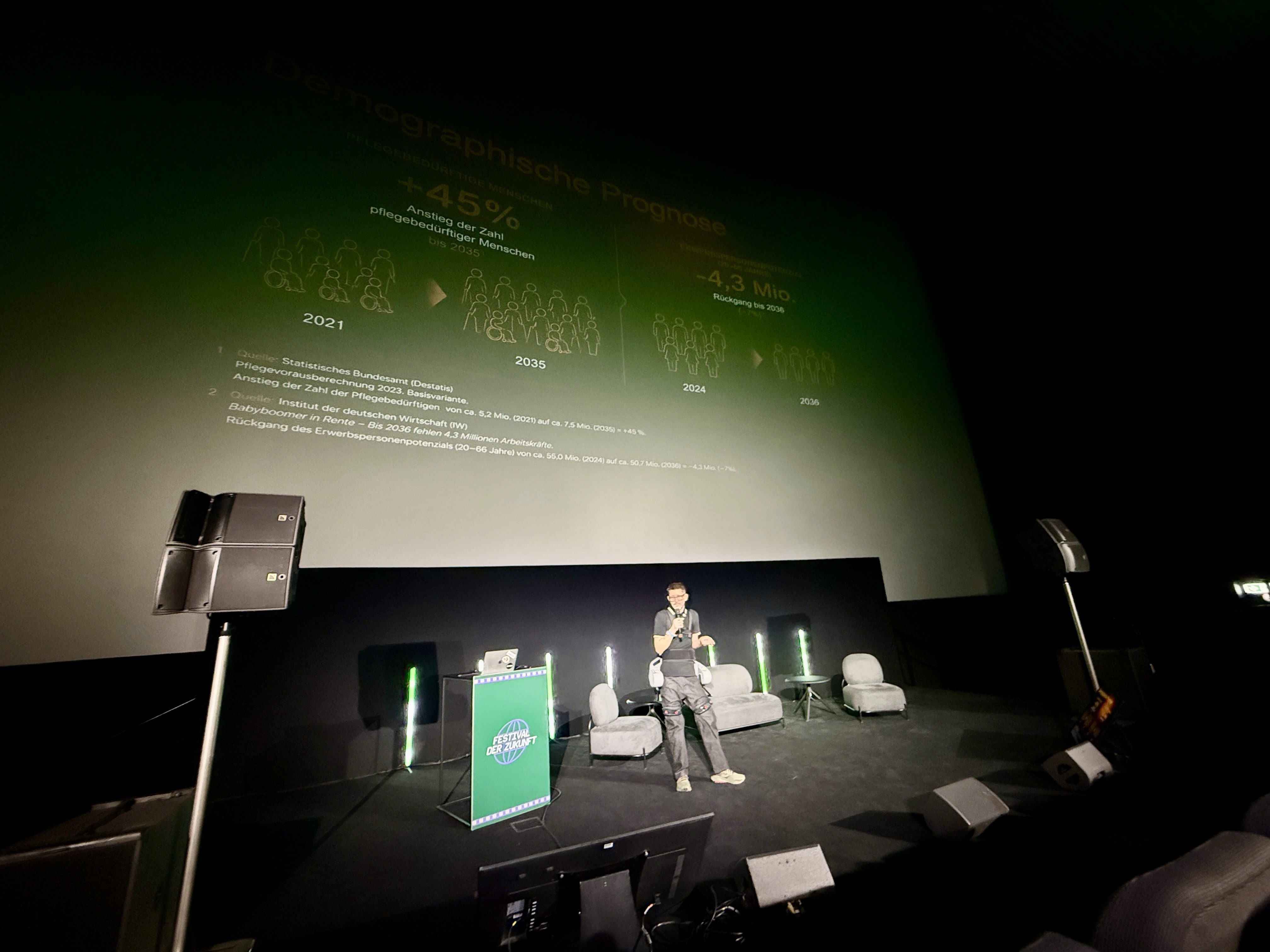
This idea is explored in a recent 1E9 feature, "Artifizielle Kraft für eine alternde Gesellschaft" by Michael Foertsch, which examines how Human Augmentation and Physical AI could reshape the way we think about ageing. The article features German Bionic Chief Creative Officer Eric Eitel, who also expanded on these ideas during his talk at Festival der Zukunft in Munich.
The discussion begins with a simple shift in perspective. Rather than asking how technology can support people once they have become patients, the more transformative question is: How can technology help extend independence before dependency begins?
This is where Human Augmentation offers a fundamentally different approach.
Unlike technologies designed to replace human capabilities, AI-powered exoskeletons work together with the body. They provide assistance only when it is needed, helping people continue performing movements themselves while reducing physical strain. The goal is not automation. It is preserving human capability.
Today, this approach is already creating measurable benefits in logistics, manufacturing, airports, healthcare and other physically demanding industries. AI-powered wearable robotics can reduce repetitive strain, support healthier working lives and help experienced professionals remain active in their jobs for longer.
At German Bionic, however, today's workplace applications are only one part of a much larger vision.
Behind EXIA, the world's most powerful active back-support exoskeleton, lies a comprehensive Physical AI platform. German Bionic has developed its own proprietary operating system for exoskeletons, bringing together AI, robotics, advanced sensors and billions of real-world human movement data points into a connected, software-defined wearable robotics platform.
Unlike conventional assistive devices, EXIA is designed to continuously evolve. Its capabilities improve through over-the-air software updates, while AI models continuously learn from real-world movement data to deliver increasingly adaptive, context-aware assistance. Rather than building static hardware, German Bionic has created a Physical AI platform that learns, adapts and expands over time.
This technological foundation reaches far beyond today's industrial applications.
The same platform that is already helping workers lift, carry and move more safely in warehouses, factories and hospitals has the potential to enable entirely new Human Augmentation applications in the years ahead. As demographic change accelerates, Physical AI could support older adults in remaining active, mobile and independent for longer, extending quality of life while reducing physical burden. In this sense, German Bionic is not only developing products for today's workplaces, but also building the technological foundation for the next generation of human-centric assistive systems.
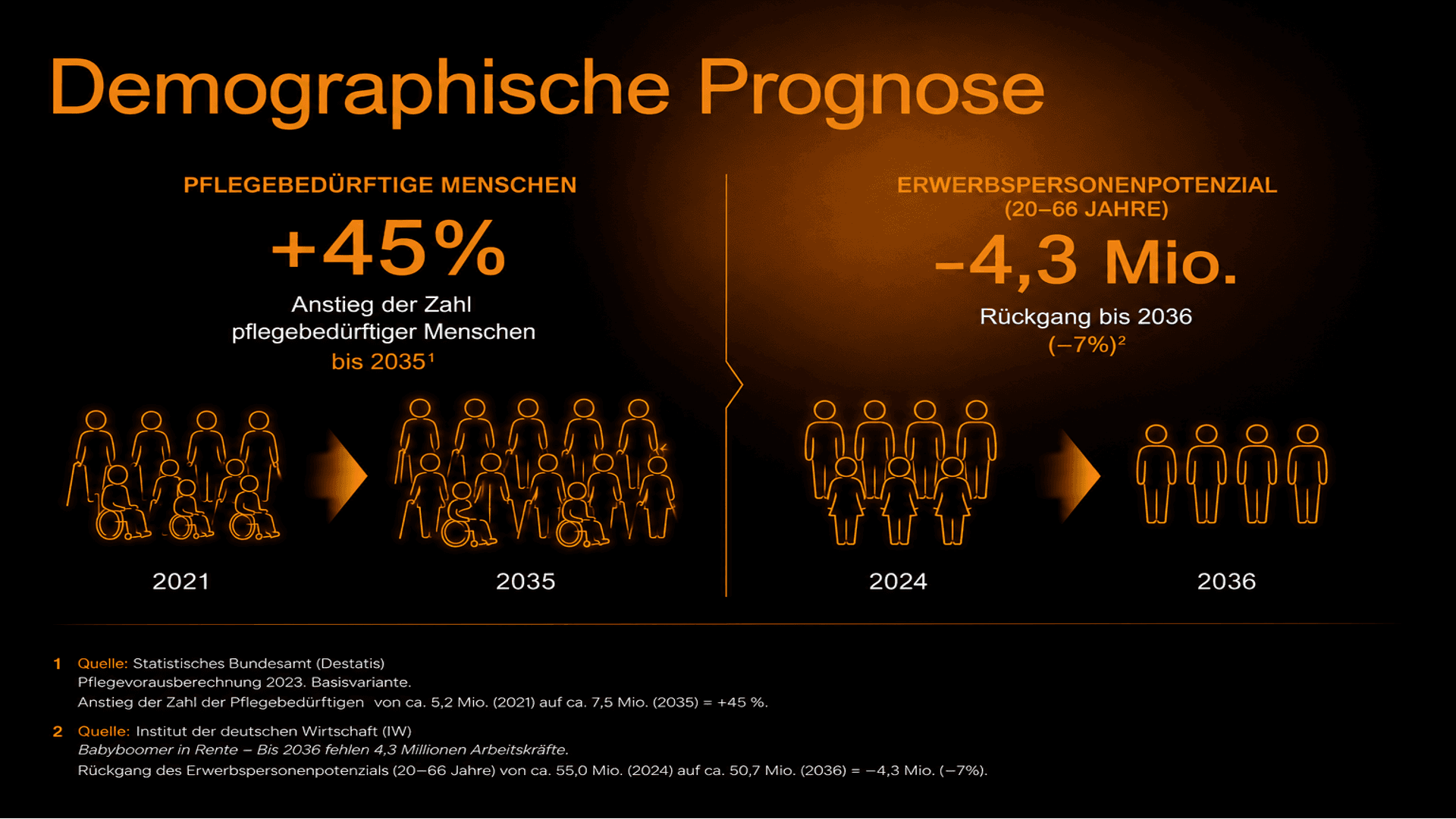
(Infographic: By 2035, the number of people requiring care is projected to increase by 45%, while the working-age population is expected to decline by 4.3 million)
This broader vision formed the core of Eric Eitel's presentation at Festival der Zukunft. His talk argued that one of the defining AgeTech challenges of the coming decades will not simply be extending life expectancy, but extending independence. Human Augmentation represents an opportunity to shift our focus from managing dependency to preserving capability.
The discussion is only beginning. But one thing is already becoming clear: the technologies that will shape ageing societies are likely to be those that empower people rather than replace them.
The conversation will continue this autumn. In October, German Bionic's Chief Product Officer and Co-CTO, Norma Steller, will speak at AgeTechX Berlin, where she will share the technology perspective behind Physical AI and discuss how intelligent wearable robotics can help address the challenges of ageing societies while shaping the next generation of Human Augmentation.
This idea is explored in a recent 1E9 feature, "Artifizielle Kraft für eine alternde Gesellschaft" by Michael Foertsch, which examines how Human Augmentation and Physical AI could reshape the way we think about ageing. The article features German Bionic Chief Creative Officer Eric Eitel, who also expanded on these ideas during his talk at Festival der Zukunft in Munich.
The discussion begins with a simple shift in perspective. Rather than asking how technology can support people once they have become patients, the more transformative question is: How can technology help extend independence before dependency begins?
This is where Human Augmentation offers a fundamentally different approach.
Unlike technologies designed to replace human capabilities, AI-powered exoskeletons work together with the body. They provide assistance only when it is needed, helping people continue performing movements themselves while reducing physical strain. The goal is not automation. It is preserving human capability.
Today, this approach is already creating measurable benefits in logistics, manufacturing, airports, healthcare and other physically demanding industries. AI-powered wearable robotics can reduce repetitive strain, support healthier working lives and help experienced professionals remain active in their jobs for longer.
At German Bionic, however, today's workplace applications are only one part of a much larger vision.
Behind EXIA, the world's most powerful active back-support exoskeleton, lies a comprehensive Physical AI platform. German Bionic has developed its own proprietary operating system for exoskeletons, bringing together AI, robotics, advanced sensors and billions of real-world human movement data points into a connected, software-defined wearable robotics platform.
Unlike conventional assistive devices, EXIA is designed to continuously evolve. Its capabilities improve through over-the-air software updates, while AI models continuously learn from real-world movement data to deliver increasingly adaptive, context-aware assistance. Rather than building static hardware, German Bionic has created a Physical AI platform that learns, adapts and expands over time.
This technological foundation reaches far beyond today's industrial applications.
The same platform that is already helping workers lift, carry and move more safely in warehouses, factories and hospitals has the potential to enable entirely new Human Augmentation applications in the years ahead. As demographic change accelerates, Physical AI could support older adults in remaining active, mobile and independent for longer, extending quality of life while reducing physical burden. In this sense, German Bionic is not only developing products for today's workplaces, but also building the technological foundation for the next generation of human-centric assistive systems.
(Infographic: By 2035, the number of people requiring care is projected to increase by 45%, while the working-age population is expected to decline by 4.3 million)
This broader vision formed the core of Eric Eitel's presentation at Festival der Zukunft. His talk argued that one of the defining AgeTech challenges of the coming decades will not simply be extending life expectancy, but extending independence. Human Augmentation represents an opportunity to shift our focus from managing dependency to preserving capability.
The discussion is only beginning. But one thing is already becoming clear: the technologies that will shape ageing societies are likely to be those that empower people rather than replace them.
The conversation will continue this autumn. In October, German Bionic's Chief Product Officer and Co-CTO, Norma Steller, will speak at AgeTechX Berlin, where she will share the technology perspective behind Physical AI and discuss how intelligent wearable robotics can help address the challenges of ageing societies while shaping the next generation of Human Augmentation.
 German Bionic Logo