AI to Wear: German Bionic Presents the Exia robotic Exoskeleton at CES 2026
AI to Wear: German Bionic Presents the Exia robotic Exoskeleton at CES 2026
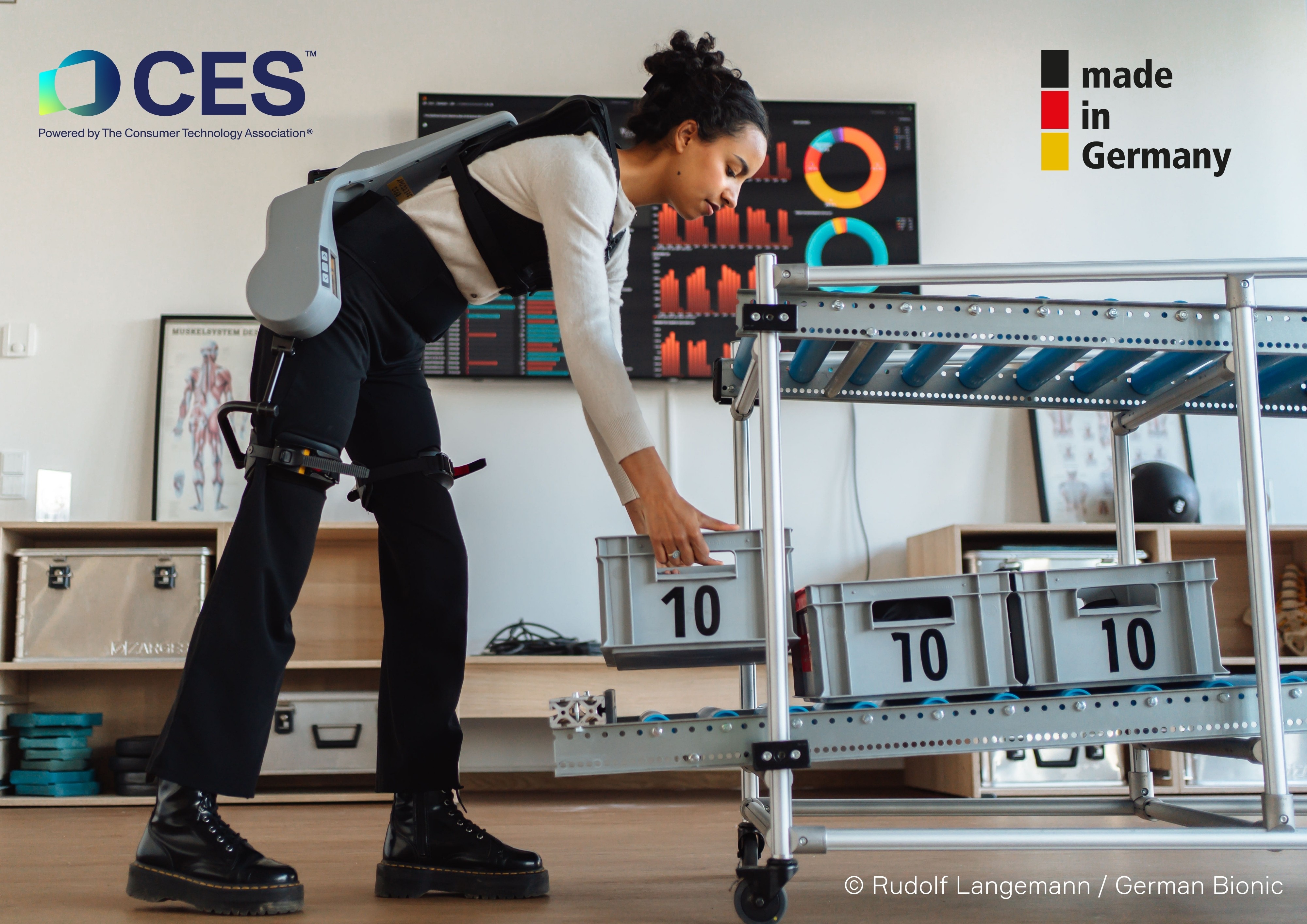
• Human augmentation technology supporting people in logistics, production, and nursing – where physical work is most demanding • World’s most powerful series-production exoskeleton with up to 38 kg (84 lbs.) of dynamic lift support per movement • Powered by Augmented AI trained on billions of real human motion data points to deliver Physical AI with adaptive, personalized support • Live experience and hands-on testing at CES 2026, German Pavilion, hosted by the German Federal Government, Hall A – Stand 51242-18
• Human augmentation technology supporting people in logistics, production, and nursing – where physical work is most demanding • World’s most powerful series-production exoskeleton with up to 38 kg (84 lbs.) of dynamic lift support per movement • Powered by Augmented AI trained on billions of real human motion data points to deliver Physical AI with adaptive, personalized support • Live experience and hands-on testing at CES 2026, German Pavilion, hosted by the German Federal Government, Hall A – Stand 51242-18
Copy link to share
Copy link to share
Link copied to clipboard !
Copy link to share
Link copied to clipboard !
Berlin, December 4, 2025 – German Bionic, the global robotics pioneer that first connected exoskeletons to the cloud, will present its newest exoskeleton, Exia, at CES 2026 in Las Vegas from January 6–9, 2026. For German Bionic, CES 2026 marks its fifth consecutive year exhibiting at the world’s leading technology show. The company has previously been recognized at CES for its power suits with a Best of Innovation Award in the Wearable Technologies category.
From Artificial Intelligence to Physical Intelligence
With Exia, German Bionic bridges the gap between digital intelligence and physical work. As a Physical AI system, Exia does not merely analyze tasks – it acts directly in the real world, supporting human movement in real time. At its core is German Bionic’s proprietary Augmented AI: AI trained not on simulations alone, but on billions of anonymized motion data points created by real people in real working environments across logistics, manufacturing, retail, airports, and healthcare.
The result is a wearable robotic system that understands how people truly lift, walk, carry, bend, and move at work – and delivers precisely targeted support from the very first use, while continuously learning and refining its behavior over time. Through regular over-the-air (OTA) updates, Exia can also gain new functions and enhancements throughout its lifecycle, ensuring that the system remains future-proof and that customer investments are protected for the long term.
Multi-industry, one device via Augmented AI
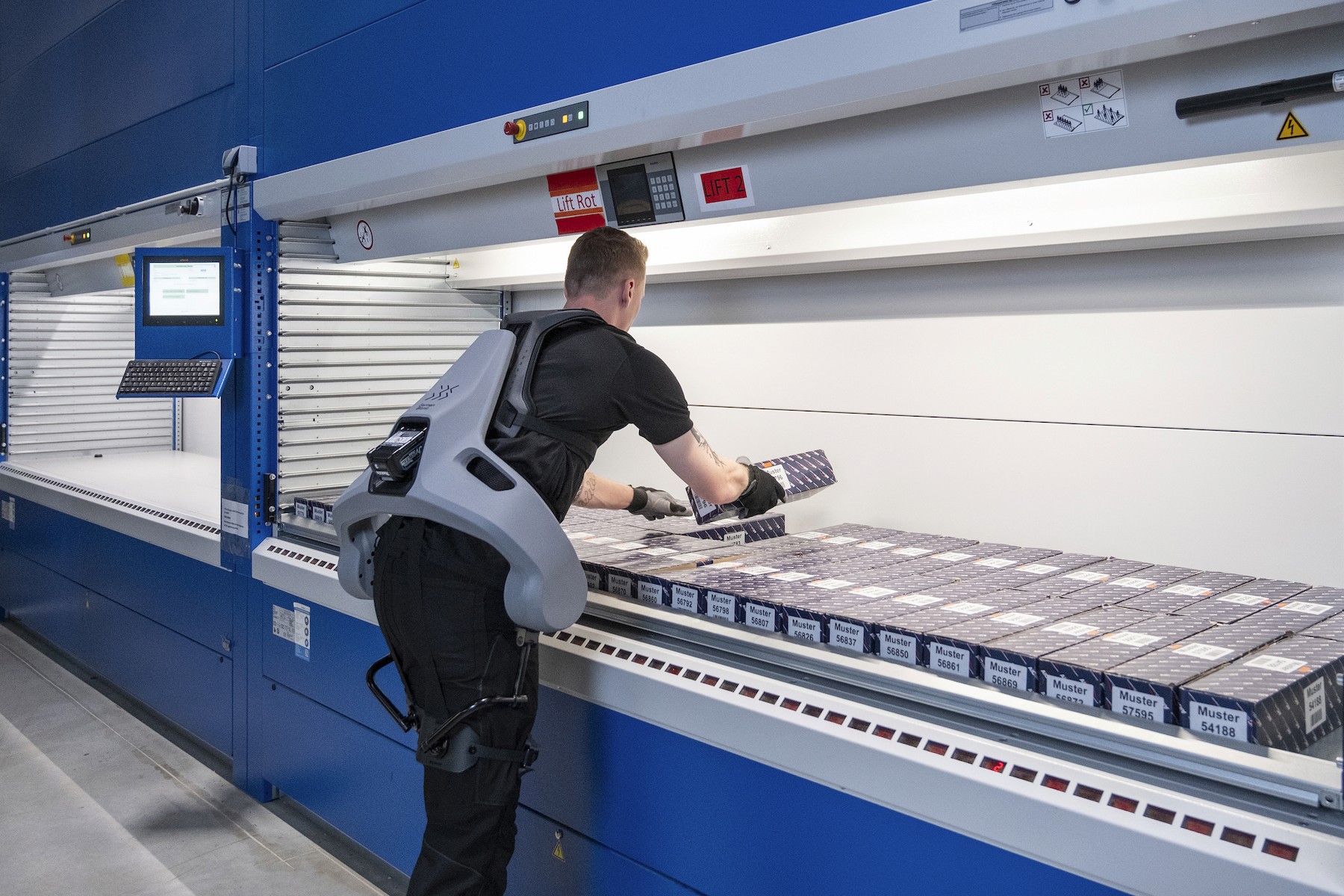
Exia provides up to 84 lbs. (38 kg) of dynamic lifting assistance per movement and actively supports walking, carrying, and work in bent-over positions. Lightweight, robust, and fully connected, it is designed as a one-for-all solution for physically demanding jobs across industries.
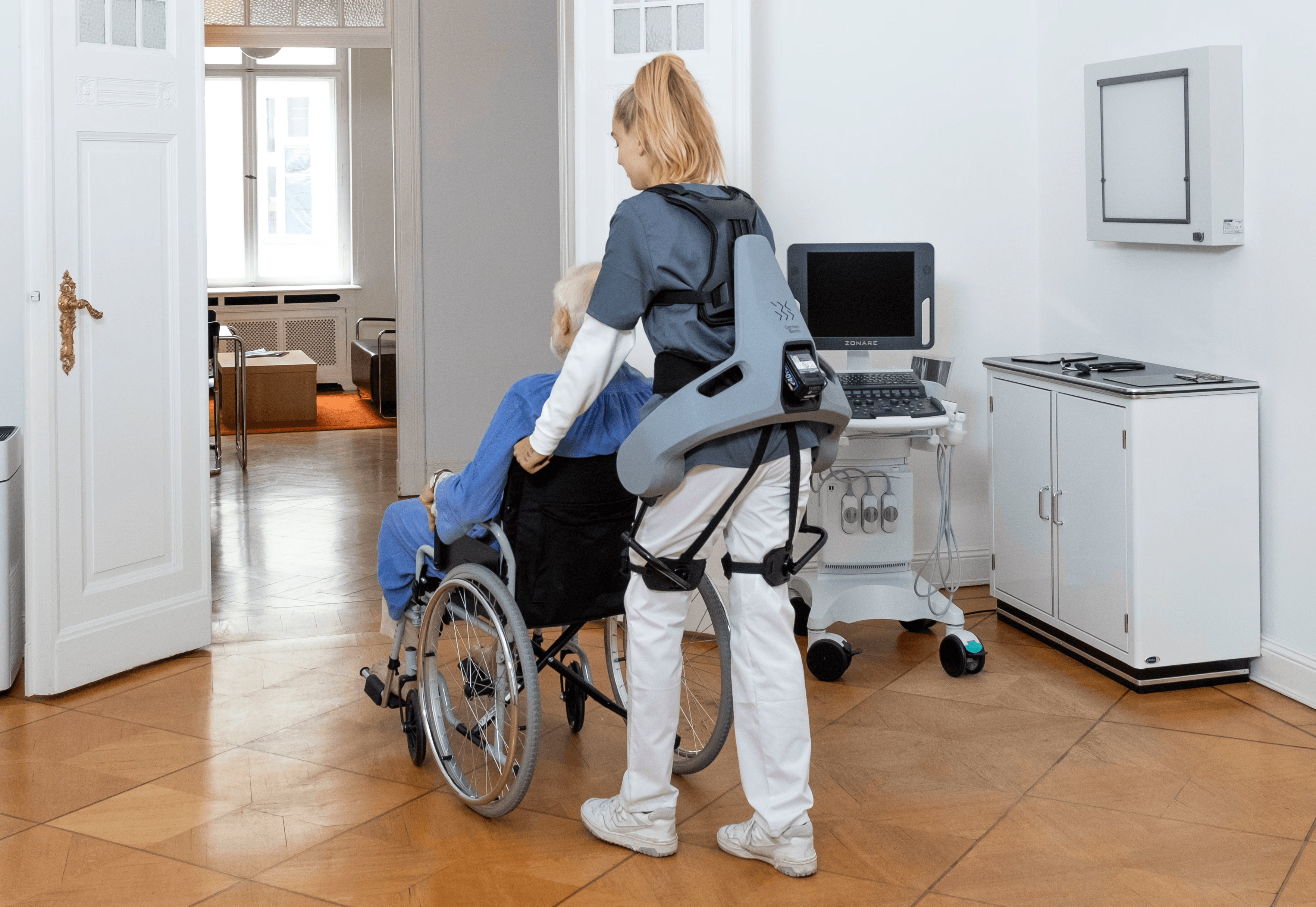
A true multi-purpose system, it tackles a wide range of demanding use cases with a single device. In logistics and intralogistics, it supports repetitive lifting, pallet handling, picking, loading, and carrying over long distances. In production and manufacturing, it assists with assembly work, machine loading, material handling, and prolonged tasks in bent or awkward postures. In healthcare and nursing, Exia supports patient mobilization, repositioning, transfers between beds and wheelchairs, as well as physically demanding care routines. What makes this possible is Exia’s Augmented AI, which continuously interprets context, movement patterns, and loads to adapt its support dynamically to each task and each wearer. Instead of requiring different exoskeletons for different jobs, Exia delivers intelligent, situation-aware support across industries – from the same wearable system.
Human-Centered Physical AI for Real-World Challenges
Exia is not designed to replace people, but to augment human capabilities. It directly addresses some of the most pressing challenges in today’s working world: rising rates of musculoskeletal disorders (MSDs), demographic change, labor shortages, and increasing physical workloads.
By actively supporting the lower back and adapting in real time to individual users and tasks, Exia helps reduce injury risk, increase productivity, and extend healthy working lives. This makes physically demanding jobs safer, more inclusive, and more attractive – a decisive factor for recruitment and long-term retention.
“What motivates us most is what Exia does for the people who keep our societies running every day,” says Norma Steller, Chief Technology Officer at German Bionic. “Whether in warehouses, on production floors, or in nursing wards – these are physically demanding, system-critical jobs. Exia is built to take real loads off their backs, reduce strain in every movement, and help them get through demanding shifts in a healthier, safer, and less tiring way. Supporting these workers with intelligent, reliable technology is not a future vision for us – it is exactly what Exia is already doing today.”
Connected Intelligence: Exia, Connect App & German Bionic IO
Exia is part of German Bionic’s fully connected 360° Human Augmentation ecosystem. Through the German Bionic Connect App, users gain access to individual settings, usage analytics, and personal performance insights. At fleet level, the German Bionic IO data insights platform enables ergonomic assessments, activity monitoring, and professional fleet management via an intuitive dashboard.
This integrated system transforms manual handling into a data-driven, digitally supported workflow – turning physical work into a measurable, optimizable, and safer way process.
“Our core systems in Physical AI, robotics, and human–machine interaction are already deployed in real working environments today,” says Armin G. Schmidt, CEO and co-founder of German Bionic. “Our new Exia exoskeleton actively uses and operationalizes this technology at the highest level – applying Physical AI directly to the human body to deliver immediate, measurable support in physically demanding jobs. This strengthens health, inclusion, and sustainability at scale. And being part of German Bionic’s Physical AI platform, the technology will continuously evolve to soon extend far beyond today’s work use cases, to also help people remain active, independent, and mobile longer as populations age, across many areas of life and leisure.”
Experience Exia Live at CES 2026
At the German Pavilion, hosted by the German Federal Government, CES visitors can try on Exia themselves and experience firsthand how Augmented AI and Physical AI work together to support human movement intelligently and intuitively in real time.
Event details:
CES 2026 – Consumer Electronics Show
January 6–9, 2026
Las Vegas Convention Center
German Pavilion – Hall A, Stand 51242-18
Press Contact:
Eric Eitel
CCO / Head of Global Communications
Mobile: +49 (0) 175 338 0453
Email: ee@germanbionic.com
Berlin, December 4, 2025 – German Bionic, the global robotics pioneer that first connected exoskeletons to the cloud, will present its newest exoskeleton, Exia, at CES 2026 in Las Vegas from January 6–9, 2026. For German Bionic, CES 2026 marks its fifth consecutive year exhibiting at the world’s leading technology show. The company has previously been recognized at CES for its power suits with a Best of Innovation Award in the Wearable Technologies category.
From Artificial Intelligence to Physical Intelligence
With Exia, German Bionic bridges the gap between digital intelligence and physical work. As a Physical AI system, Exia does not merely analyze tasks – it acts directly in the real world, supporting human movement in real time. At its core is German Bionic’s proprietary Augmented AI: AI trained not on simulations alone, but on billions of anonymized motion data points created by real people in real working environments across logistics, manufacturing, retail, airports, and healthcare.
The result is a wearable robotic system that understands how people truly lift, walk, carry, bend, and move at work – and delivers precisely targeted support from the very first use, while continuously learning and refining its behavior over time. Through regular over-the-air (OTA) updates, Exia can also gain new functions and enhancements throughout its lifecycle, ensuring that the system remains future-proof and that customer investments are protected for the long term.
Multi-industry, one device via Augmented AI
Exia provides up to 84 lbs. (38 kg) of dynamic lifting assistance per movement and actively supports walking, carrying, and work in bent-over positions. Lightweight, robust, and fully connected, it is designed as a one-for-all solution for physically demanding jobs across industries.
A true multi-purpose system, it tackles a wide range of demanding use cases with a single device. In logistics and intralogistics, it supports repetitive lifting, pallet handling, picking, loading, and carrying over long distances. In production and manufacturing, it assists with assembly work, machine loading, material handling, and prolonged tasks in bent or awkward postures. In healthcare and nursing, Exia supports patient mobilization, repositioning, transfers between beds and wheelchairs, as well as physically demanding care routines. What makes this possible is Exia’s Augmented AI, which continuously interprets context, movement patterns, and loads to adapt its support dynamically to each task and each wearer. Instead of requiring different exoskeletons for different jobs, Exia delivers intelligent, situation-aware support across industries – from the same wearable system.
Human-Centered Physical AI for Real-World Challenges
Exia is not designed to replace people, but to augment human capabilities. It directly addresses some of the most pressing challenges in today’s working world: rising rates of musculoskeletal disorders (MSDs), demographic change, labor shortages, and increasing physical workloads.
By actively supporting the lower back and adapting in real time to individual users and tasks, Exia helps reduce injury risk, increase productivity, and extend healthy working lives. This makes physically demanding jobs safer, more inclusive, and more attractive – a decisive factor for recruitment and long-term retention.
“What motivates us most is what Exia does for the people who keep our societies running every day,” says Norma Steller, Chief Technology Officer at German Bionic. “Whether in warehouses, on production floors, or in nursing wards – these are physically demanding, system-critical jobs. Exia is built to take real loads off their backs, reduce strain in every movement, and help them get through demanding shifts in a healthier, safer, and less tiring way. Supporting these workers with intelligent, reliable technology is not a future vision for us – it is exactly what Exia is already doing today.”
Connected Intelligence: Exia, Connect App & German Bionic IO
Exia is part of German Bionic’s fully connected 360° Human Augmentation ecosystem. Through the German Bionic Connect App, users gain access to individual settings, usage analytics, and personal performance insights. At fleet level, the German Bionic IO data insights platform enables ergonomic assessments, activity monitoring, and professional fleet management via an intuitive dashboard.
This integrated system transforms manual handling into a data-driven, digitally supported workflow – turning physical work into a measurable, optimizable, and safer way process.
“Our core systems in Physical AI, robotics, and human–machine interaction are already deployed in real working environments today,” says Armin G. Schmidt, CEO and co-founder of German Bionic. “Our new Exia exoskeleton actively uses and operationalizes this technology at the highest level – applying Physical AI directly to the human body to deliver immediate, measurable support in physically demanding jobs. This strengthens health, inclusion, and sustainability at scale. And being part of German Bionic’s Physical AI platform, the technology will continuously evolve to soon extend far beyond today’s work use cases, to also help people remain active, independent, and mobile longer as populations age, across many areas of life and leisure.”
Experience Exia Live at CES 2026
At the German Pavilion, hosted by the German Federal Government, CES visitors can try on Exia themselves and experience firsthand how Augmented AI and Physical AI work together to support human movement intelligently and intuitively in real time.
Event details:
CES 2026 – Consumer Electronics Show
January 6–9, 2026
Las Vegas Convention Center
German Pavilion – Hall A, Stand 51242-18
Press Contact:
Eric Eitel
CCO / Head of Global Communications
Mobile: +49 (0) 175 338 0453
Email: ee@germanbionic.com
 German Bionic Logo