Where Tradition Meets Physical AI: How AI-Powered Exoskeletons Are Supporting Modern Winemaking
Where Tradition Meets Physical AI: How AI-Powered Exoskeletons Are Supporting Modern Winemaking
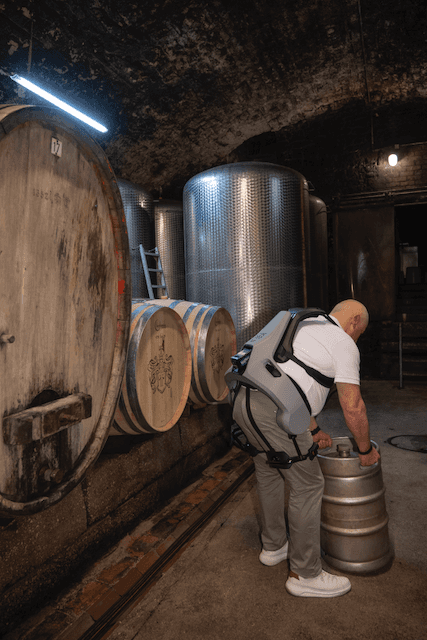
Winemaking has always been a craft shaped by experience, precision, and physical dedication. From moving heavy wine barrels in centuries-old cellars to transporting crates, tools, and equipment across vineyards, the work remains demanding throughout the entire production process. At the historic Graf von Bentzel-Sturmfeder Winery in Schozach, Germany, tradition and cutting-edge technology are coming together in a new way. The AI-powered exoskeleton EXIA supports winery staff wherever physical strain is greatest, helping reduce workload while preserving the craftsmanship that defines great wine.
Winemaking has always been a craft shaped by experience, precision, and physical dedication. From moving heavy wine barrels in centuries-old cellars to transporting crates, tools, and equipment across vineyards, the work remains demanding throughout the entire production process. At the historic Graf von Bentzel-Sturmfeder Winery in Schozach, Germany, tradition and cutting-edge technology are coming together in a new way. The AI-powered exoskeleton EXIA supports winery staff wherever physical strain is greatest, helping reduce workload while preserving the craftsmanship that defines great wine.
Copy link to share
Copy link to share
Link copied to clipboard !
Copy link to share
Link copied to clipboard !
Smart Assistance for Heavy Work
Whether handling barrels, lifting wine crates, or transporting materials, many tasks in a winery involve repetitive lifting and carrying in confined spaces.
Powered by billions of real-world movement data points, EXIA recognizes a user’s motion in real time and delivers adaptive lift support exactly when needed. By reducing strain on the lower back and joints, it helps combat fatigue while allowing workers to move naturally and freely. This makes it particularly valuable in historic wine cellars, where flexibility and mobility are just as important as strength.
Beyond the Cellar
The benefits extend well beyond the winery building.
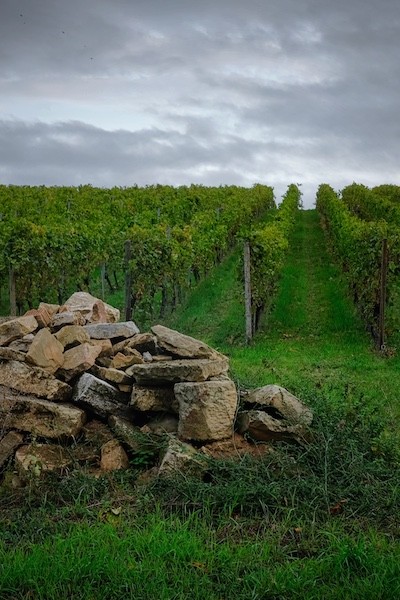
Thanks to its IP54-rated protection against dust and water spray, EXIA is equally suited for outdoor work. In vineyards, it assists with transporting tools, equipment, and materials, while also supporting physically demanding manual tasks across uneven terrain.
From vineyard to cellar, Physical AI is becoming a practical companion for some of the wine industry’s most physically intensive work.
Preserving Craftsmanship Through Human Augmentation
Wine production represents a growing number of industries where valuable expertise still depends on physically demanding work. Human Augmentation offers a different vision for the future: not replacing skilled workers, but enabling them to perform demanding tasks more safely, comfortably, and sustainably.
By combining AI with wearable robotics, EXIA helps reduce physical stress while allowing experienced professionals to focus on what matters most: producing exceptional wines.
Trade Press Spotlight: Exoskeletons in Winemaking
The growing importance of wearable robotics in viticulture is also reflected in the trade press. The July 2026 issue of the German wine industry magazine Rebe & Wein features an in-depth article on the use of exoskeletons in vineyards and wineries, highlighting how Human Augmentation is helping make one of the world’s oldest crafts more sustainable for the future.
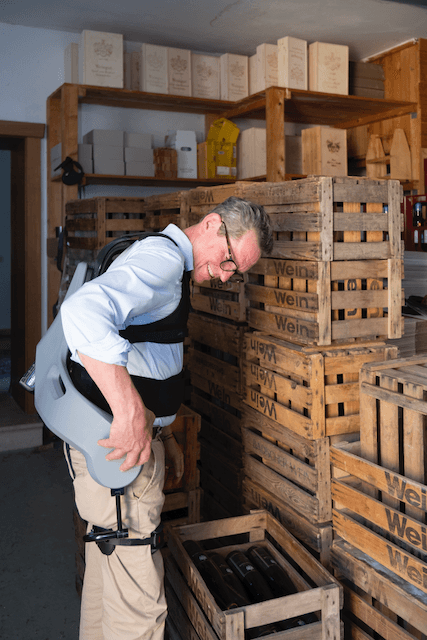
(Photo: Kilian Graf von Bentzel-Sturmfeder stacking wine crates while wearing EXIA)
The example of Graf von Bentzel-Sturmfeder Winery shows that tradition and innovation are not opposites. Together, they create new opportunities to protect people, preserve craftsmanship, and shape the future of winemaking.
Smart Assistance for Heavy Work
Whether handling barrels, lifting wine crates, or transporting materials, many tasks in a winery involve repetitive lifting and carrying in confined spaces.
Powered by billions of real-world movement data points, EXIA recognizes a user’s motion in real time and delivers adaptive lift support exactly when needed. By reducing strain on the lower back and joints, it helps combat fatigue while allowing workers to move naturally and freely. This makes it particularly valuable in historic wine cellars, where flexibility and mobility are just as important as strength.
Beyond the Cellar
The benefits extend well beyond the winery building.
Thanks to its IP54-rated protection against dust and water spray, EXIA is equally suited for outdoor work. In vineyards, it assists with transporting tools, equipment, and materials, while also supporting physically demanding manual tasks across uneven terrain.
From vineyard to cellar, Physical AI is becoming a practical companion for some of the wine industry’s most physically intensive work.
Preserving Craftsmanship Through Human Augmentation
Wine production represents a growing number of industries where valuable expertise still depends on physically demanding work. Human Augmentation offers a different vision for the future: not replacing skilled workers, but enabling them to perform demanding tasks more safely, comfortably, and sustainably.
By combining AI with wearable robotics, EXIA helps reduce physical stress while allowing experienced professionals to focus on what matters most: producing exceptional wines.
Trade Press Spotlight: Exoskeletons in Winemaking
The growing importance of wearable robotics in viticulture is also reflected in the trade press. The July 2026 issue of the German wine industry magazine Rebe & Wein features an in-depth article on the use of exoskeletons in vineyards and wineries, highlighting how Human Augmentation is helping make one of the world’s oldest crafts more sustainable for the future.
(Photo: Kilian Graf von Bentzel-Sturmfeder stacking wine crates while wearing EXIA)
The example of Graf von Bentzel-Sturmfeder Winery shows that tradition and innovation are not opposites. Together, they create new opportunities to protect people, preserve craftsmanship, and shape the future of winemaking.
 ロゴ
ロゴ