Human-Centric Robotics Takes Off: Supporting the People Who Keep Airports Moving
Human-Centric Robotics Takes Off: Supporting the People Who Keep Airports Moving

German Bionic will showcase its AI-powered EXIA exoskeleton for ground handling and air cargo at GSE Expo Europe, 15–17 September 2026 at FIL Lisbon, Stand C01A.
German Bionic will showcase its AI-powered EXIA exoskeleton for ground handling and air cargo at GSE Expo Europe, 15–17 September 2026 at FIL Lisbon, Stand C01A.
Copy link to share
Copy link to share
Link copied to clipboard !
Copy link to share
Link copied to clipboard !
Airports are becoming increasingly automated. Autonomous vehicles, intelligent baggage systems, digital cargo platforms and AI are changing how people, luggage and goods move through airports.
But there is another side to airport operations that remains remarkably physical.
Every day, ground handling and air cargo teams lift and move thousands of suitcases, parcels and pieces of freight. They load and unload aircraft and containers, transfer baggage from chutes to trolleys, work in confined spaces and repeatedly bend, reach, lift and carry.
These are also precisely the environments in which the flexibility, perception and decision-making of people are difficult to replace.
So rather than asking how we can automate every physical task, there is another question worth asking:
How can robotics make the people doing these jobs stronger, safer and less physically strained?
That is the idea behind human-centric robotics.
👉 Make an appointment with our team now and experience EXIA in action at GSE Expo Europe.
Bringing robotics to the worker
Instead of separating people from the process, wearable robotics brings intelligent physical assistance directly to them.
German Bionic’s AI-powered EXIA exoskeleton is designed for exactly these kinds of real-world workflows.
Worn like a backpack, EXIA provides active support during lifting, lowering, carrying, loading and work in forward-bent positions. Its AI-based control system recognizes movement patterns and dynamically adapts its assistance to the individual user and task.
The system has learned from billions of data points collected from real-world human movements across logistics, manufacturing, airports, retail and healthcare. This enables EXIA to provide assistance precisely when it is needed while allowing workers to move naturally.
With up to 38 kg / 84 lbs of adaptive lifting assistance per movement, EXIA can significantly reduce the physical load placed on the lower back during demanding tasks.
And that matters at airports.
One airport, many physical use cases
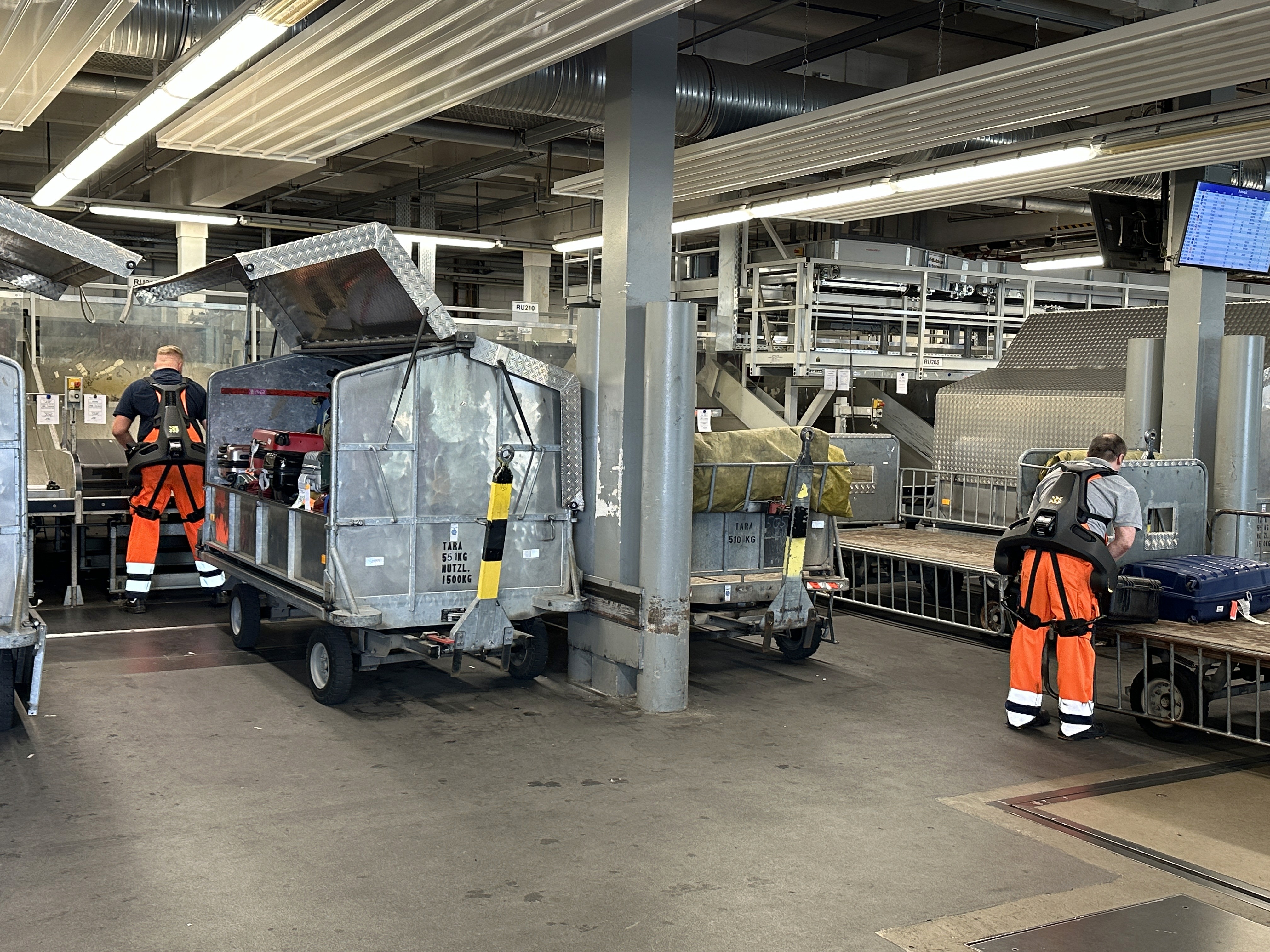
Ground handling is not a single repetitive movement performed in a controlled environment.
A baggage handler might lift a suitcase from a conveyor, lower it onto a trolley, pull and position equipment, carry individual items and then work bent forward while loading baggage into an aircraft.
Air cargo brings another set of challenges. Freight varies enormously in size, shape and weight. Employees move between warehouses, loading areas and the apron and frequently switch between lifting, carrying, positioning and forward-bent work.
This variability is one reason people remain so important.
It is also where an intelligent wearable system can make a difference.
EXIA adapts dynamically as the task changes. Instead of providing rigid assistance for one predefined movement, its support responds to what the wearer is actually doing.
Typical airport applications include:
Loading and unloading passenger baggage
Moving baggage between conveyor belts, chutes and trolleys
Loading baggage in confined aircraft spaces
Lifting and positioning parcels and cargo
Warehouse and air freight handling
Loading and unloading unit load devices and cargo containers
Repetitive lifting and lowering
Carrying loads
Work in prolonged forward-bent positions
The objective is not to change the workflow around the technology. The technology adapts to the person and the workflow.
👉 Make an appointment with our team now and experience EXIA in action at GSE Expo Europe.
Baggage handling at Nuremberg Airport
The potential of this approach can already be seen in daily airport operations.
At Nuremberg Airport, baggage handlers deal with hundreds of suitcases every day, with individual pieces weighing as much as 32 kilograms.
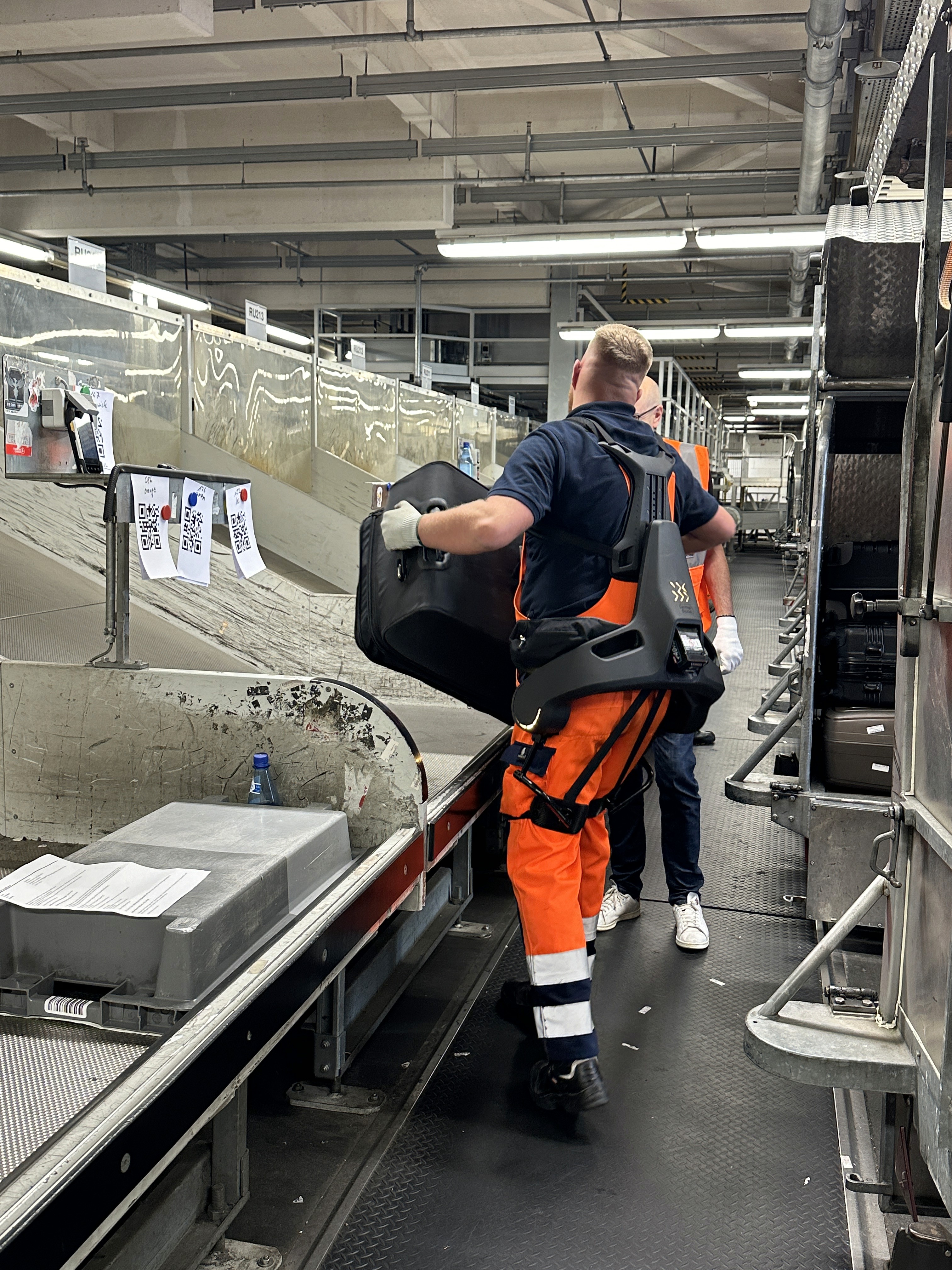
The challenge is not simply one heavy suitcase. It is the accumulated physical load created by lifting, lowering, reaching and bending hundreds of times over the course of a shift.
Nuremberg Airport introduced German Bionic exoskeletons to support its ground handling teams and reduce strain on employees’ backs.
The technology is used during ongoing operations, including the short, repetitive lifting movements involved in transferring baggage from chutes onto transport trolleys.
For the airport, the technology is not aimed only at employees who have already spent many years in physically demanding jobs. It can also help protect younger colleagues entering the profession.
That changes the perspective on workplace ergonomics.
Instead of intervening only after years of physical strain have taken their toll, wearable robotics can become part of a preventative approach to occupational health from the beginning of a career.
From baggage to air cargo: Maastricht Aachen Airport
The same principle extends beyond passenger baggage.
At Maastricht Aachen Airport, EXIA is being used in daily cargo handling operations, making the airport the first in the Netherlands to introduce the AI-powered system into its operational cargo workflows.
Cargo teams move tonnes of freight, baggage and parcels. Again, the key ergonomic challenge is not necessarily one spectacularly heavy lift. It is the cumulative strain created by thousands of physical movements.
EXIA supports workers while allowing them to retain the mobility and flexibility required in an active airport environment.
That distinction is important.
A robotic system designed to automate a fixed task typically requires a predictable environment. Ground handling and cargo operations are often the opposite: changing loads, changing aircraft, changing positions, time pressure and unexpected situations are part of everyday work.
People adapt naturally.
Human-centric robotics allows the technology to adapt with them.
Physical AI for the airport
This points toward a broader development in robotics.
For decades, industrial robotics has largely meant machines operating separately from people, performing highly standardized tasks.
Physical AI expands that model.
Intelligence no longer exists only in software or behind a screen. It can perceive physical activity and translate that understanding into physical assistance in real time.
With EXIA, sensors and AI recognize what the wearer is doing. The system responds with appropriate support and continuously adapts to the person and task.
Because EXIA is connected, the technology can also continue to improve through software. Over-the-air updates can refine movement recognition and support characteristics without replacing the physical device.
For airport operators, this opens up a new category between manual work and full automation.
Not every process has to become autonomous to benefit from robotics.
Ergonomics becomes a workforce issue
There is another reason why this matters.
Airports, airlines and ground handling providers are competing for skilled workers while simultaneously trying to retain experienced employees in physically demanding roles.
Musculoskeletal strain, fatigue and injuries are therefore more than occupational health issues. They affect staffing, absence rates, operational resilience and ultimately the attractiveness of the job itself.
Reducing physical strain can help make demanding airport jobs more sustainable across an entire working life.
It can also make these roles accessible to a broader range of people.
Instead of designing physically demanding jobs around an assumed level of strength, intelligent assistance can help compensate for differences between individuals.
This is where ergonomics, technology and workforce strategy increasingly meet.
Automation and augmentation belong together
None of this is an argument against airport automation.
Quite the opposite.
Automation makes enormous sense wherever processes can be standardized and machines can perform tasks more efficiently or safely.
But the airport of the future will not consist exclusively of autonomous machines.
It will also depend on people responding to situations, handling exceptions, making decisions and performing complex physical tasks.
The opportunity is therefore to combine both approaches.
Automate where automation works. Augment where people remain essential.
Human-centric robotics adds another tool to the airport technology stack: one designed specifically around the capabilities of the human worker.
Experience human-centric robotics at GSE Expo Europe 2026

From autonomous GSE and fleet management to digitalization and new equipment concepts, GSE Expo Europe brings together many of the technologies shaping the next generation of ground operations.
German Bionic will be in Lisbon to add another perspective to that conversation:
Robotics you can wear.
Visitors can experience EXIA and discuss real-world applications for baggage handling, ground handling and air cargo with the German Bionic team.
📍 GSE Expo Europe 2026, FIL Lisbon, Portugal
📅 15–17 September 2026
📌 German Bionic, Stand C01A
See how Physical AI can support the people who keep airport operations moving.
👉 Make an appointment with our team now and experience EXIA in action at GSE Expo Europe.
Airports are becoming increasingly automated. Autonomous vehicles, intelligent baggage systems, digital cargo platforms and AI are changing how people, luggage and goods move through airports.
But there is another side to airport operations that remains remarkably physical.
Every day, ground handling and air cargo teams lift and move thousands of suitcases, parcels and pieces of freight. They load and unload aircraft and containers, transfer baggage from chutes to trolleys, work in confined spaces and repeatedly bend, reach, lift and carry.
These are also precisely the environments in which the flexibility, perception and decision-making of people are difficult to replace.
So rather than asking how we can automate every physical task, there is another question worth asking:
How can robotics make the people doing these jobs stronger, safer and less physically strained?
That is the idea behind human-centric robotics.
👉 Make an appointment with our team now and experience EXIA in action at GSE Expo Europe.
Bringing robotics to the worker
Instead of separating people from the process, wearable robotics brings intelligent physical assistance directly to them.
German Bionic’s AI-powered EXIA exoskeleton is designed for exactly these kinds of real-world workflows.
Worn like a backpack, EXIA provides active support during lifting, lowering, carrying, loading and work in forward-bent positions. Its AI-based control system recognizes movement patterns and dynamically adapts its assistance to the individual user and task.
The system has learned from billions of data points collected from real-world human movements across logistics, manufacturing, airports, retail and healthcare. This enables EXIA to provide assistance precisely when it is needed while allowing workers to move naturally.
With up to 38 kg / 84 lbs of adaptive lifting assistance per movement, EXIA can significantly reduce the physical load placed on the lower back during demanding tasks.
And that matters at airports.
One airport, many physical use cases
Ground handling is not a single repetitive movement performed in a controlled environment.
A baggage handler might lift a suitcase from a conveyor, lower it onto a trolley, pull and position equipment, carry individual items and then work bent forward while loading baggage into an aircraft.
Air cargo brings another set of challenges. Freight varies enormously in size, shape and weight. Employees move between warehouses, loading areas and the apron and frequently switch between lifting, carrying, positioning and forward-bent work.
This variability is one reason people remain so important.
It is also where an intelligent wearable system can make a difference.
EXIA adapts dynamically as the task changes. Instead of providing rigid assistance for one predefined movement, its support responds to what the wearer is actually doing.
Typical airport applications include:
Loading and unloading passenger baggage
Moving baggage between conveyor belts, chutes and trolleys
Loading baggage in confined aircraft spaces
Lifting and positioning parcels and cargo
Warehouse and air freight handling
Loading and unloading unit load devices and cargo containers
Repetitive lifting and lowering
Carrying loads
Work in prolonged forward-bent positions
The objective is not to change the workflow around the technology. The technology adapts to the person and the workflow.
👉 Make an appointment with our team now and experience EXIA in action at GSE Expo Europe.
Baggage handling at Nuremberg Airport
The potential of this approach can already be seen in daily airport operations.
At Nuremberg Airport, baggage handlers deal with hundreds of suitcases every day, with individual pieces weighing as much as 32 kilograms.
The challenge is not simply one heavy suitcase. It is the accumulated physical load created by lifting, lowering, reaching and bending hundreds of times over the course of a shift.
Nuremberg Airport introduced German Bionic exoskeletons to support its ground handling teams and reduce strain on employees’ backs.
The technology is used during ongoing operations, including the short, repetitive lifting movements involved in transferring baggage from chutes onto transport trolleys.
For the airport, the technology is not aimed only at employees who have already spent many years in physically demanding jobs. It can also help protect younger colleagues entering the profession.
That changes the perspective on workplace ergonomics.
Instead of intervening only after years of physical strain have taken their toll, wearable robotics can become part of a preventative approach to occupational health from the beginning of a career.
From baggage to air cargo: Maastricht Aachen Airport
The same principle extends beyond passenger baggage.
At Maastricht Aachen Airport, EXIA is being used in daily cargo handling operations, making the airport the first in the Netherlands to introduce the AI-powered system into its operational cargo workflows.
Cargo teams move tonnes of freight, baggage and parcels. Again, the key ergonomic challenge is not necessarily one spectacularly heavy lift. It is the cumulative strain created by thousands of physical movements.
EXIA supports workers while allowing them to retain the mobility and flexibility required in an active airport environment.
That distinction is important.
A robotic system designed to automate a fixed task typically requires a predictable environment. Ground handling and cargo operations are often the opposite: changing loads, changing aircraft, changing positions, time pressure and unexpected situations are part of everyday work.
People adapt naturally.
Human-centric robotics allows the technology to adapt with them.
Physical AI for the airport
This points toward a broader development in robotics.
For decades, industrial robotics has largely meant machines operating separately from people, performing highly standardized tasks.
Physical AI expands that model.
Intelligence no longer exists only in software or behind a screen. It can perceive physical activity and translate that understanding into physical assistance in real time.
With EXIA, sensors and AI recognize what the wearer is doing. The system responds with appropriate support and continuously adapts to the person and task.
Because EXIA is connected, the technology can also continue to improve through software. Over-the-air updates can refine movement recognition and support characteristics without replacing the physical device.
For airport operators, this opens up a new category between manual work and full automation.
Not every process has to become autonomous to benefit from robotics.
Ergonomics becomes a workforce issue
There is another reason why this matters.
Airports, airlines and ground handling providers are competing for skilled workers while simultaneously trying to retain experienced employees in physically demanding roles.
Musculoskeletal strain, fatigue and injuries are therefore more than occupational health issues. They affect staffing, absence rates, operational resilience and ultimately the attractiveness of the job itself.
Reducing physical strain can help make demanding airport jobs more sustainable across an entire working life.
It can also make these roles accessible to a broader range of people.
Instead of designing physically demanding jobs around an assumed level of strength, intelligent assistance can help compensate for differences between individuals.
This is where ergonomics, technology and workforce strategy increasingly meet.
Automation and augmentation belong together
None of this is an argument against airport automation.
Quite the opposite.
Automation makes enormous sense wherever processes can be standardized and machines can perform tasks more efficiently or safely.
But the airport of the future will not consist exclusively of autonomous machines.
It will also depend on people responding to situations, handling exceptions, making decisions and performing complex physical tasks.
The opportunity is therefore to combine both approaches.
Automate where automation works. Augment where people remain essential.
Human-centric robotics adds another tool to the airport technology stack: one designed specifically around the capabilities of the human worker.
Experience human-centric robotics at GSE Expo Europe 2026
From autonomous GSE and fleet management to digitalization and new equipment concepts, GSE Expo Europe brings together many of the technologies shaping the next generation of ground operations.
German Bionic will be in Lisbon to add another perspective to that conversation:
Robotics you can wear.
Visitors can experience EXIA and discuss real-world applications for baggage handling, ground handling and air cargo with the German Bionic team.
📍 GSE Expo Europe 2026, FIL Lisbon, Portugal
📅 15–17 September 2026
📌 German Bionic, Stand C01A
See how Physical AI can support the people who keep airport operations moving.
👉 Make an appointment with our team now and experience EXIA in action at GSE Expo Europe.
 ロゴ
ロゴ